By: Jeremiah J. Henderson
I am enjoying medicine.
That feels important to say, because it is true. I am standing in a workroom I like, with a team I like, talking about a patient I care about. I like the rhythm of this part of the day. The casual efficiency of rounds prep, the shared language, the small jokes that signal belonging. I like knowing where to stand, when to speak, when to listen. I like feeling, for a moment, like I fit.
Someone says the patient’s name.
Then a word follows.
Not loudly. Not aggressively.
Just easily.
“He—”
The sentence keeps going.
I notice the word before I notice anything else. Before I notice my own reaction, before I decide what it means, my body responds. A tightening. A heat in my chest. A brief, familiar calculation that arrives fully formed, as if it has been waiting for its cue.
They use they/them pronouns.
This was said earlier. It was said clearly. It is written down. And yet here we are.
No one else stops the conversation. No one else shifts. The sentence lands, settles, and becomes part of the room. Another sentence follows it, and another. The team keeps moving forward.
This is the moment.
It always is.
I could say nothing.
I could let it pass.
I could stay where I am—inside the safety of the group, inside the flow of learning, inside the pleasure of medicine when it feels uncomplicated.
Or I could interrupt.
I glance around the room without really meaning to. Faces neutral. Pens moving. Screens glowing. Everyone else is choosing something too, even if they do not experience it that way. Silence is also a decision. Comfort is also a choice.
I feel the familiar weight of it: belonging on one side, speaking on the other. There is no option that feels clean. There never is.
I clear my throat.
“Hey,” I say, lightly, carefully. “They use they/them pronouns.”
The room pauses—not dramatically, not unkindly. Just enough to acknowledge the correction. Someone nods. Someone says, “Oh—right,” and continues the discussion. The word is replaced. The moment passes.
Outwardly, it’s small. Polite. Professional.
Inwardly, everything has shifted.
Because what no one in the room knows is that this word does not land neutrally for me. What no one knows is that I have been on the other side of this exchange—that I have been the patient listening to providers talk about me, misgendering me, wondering if it is safe to correct them, wondering what else they might misunderstand if they cannot manage this.
What no one knows is that I am transgender.
I do not announce it. I never do, at first. Disclosure is its own calculation; one I make only when I want to. But each time this happens—each time a patient is misgendered, even casually, even “by accident”—I feel the edges of that hidden identity press closer to the surface.
Because this isn’t just about language.
It’s about safety.
The patient we are discussing is inpatient. They are here on one of the worst days of their life. They are here because something broke open and could not be held alone anymore. Later, when I sit with them, they will tell me they rarely seek mental health care—that they do not feel safe telling the full truth of their life to providers. They will tell me they’ve learned to censor themselves, to decide which parts are too risky to share.
They will also tell me that another patient said something to them on the unit—something cruel, something pointed enough that staff moved them to a different room “for safety.” They will shrug when they say it, as if this is expected. As if this is the cost of being.
And behind closed doors, in a room full of clinicians, their identity will still be treated as optional.
This happens more than once.
Not in the same way. Not with the same people or clinical rotation. But with the same quiet logic. Different services. Different buildings. Different patients. Each time, the outcome looks acceptable: I speak, the behavior changes, the moment resolves.
On paper, everything turns out fine.
But the pattern does not change.
I start to recognize it not because it is loud, but because it is quiet.
It happens in workrooms and nursing stations, in hallways where patients cannot hear us, in the places where we speak freely because we think it doesn’t count. It happens when the chart feels more present than the person, when language slips into shorthand.
A pronoun is missed.
Then missed again.
Sometimes corrected.
Sometimes not.
What stays with me is not just the word, but the silence that follows it.
I notice how often I am the only one who responds. How often my body tightens before my mind catches up. How quickly I start doing the math—how many times I can interrupt before the room shifts, before I am seen as sensitive, disruptive, difficult. I notice how everyone else remains exactly where they are.
There is a strange loneliness in that moment.
Because I am not only choosing whether to speak for the patient. I am choosing whether to protect myself.
I wonder, more than once, what people assume about me. I present as someone whose gender fits easily. Someone who belongs. Someone safe. I start to ask myself uncomfortable questions. Do they misgender patients around me because they think I am part of the in-group? Because they think I will not be harmed by it? Because they do not imagine that someone like the patient could also be in this room?
For the people with more power—the attendings, the residents, the nurses, the social workers—silence costs nothing. Not because they are unkind. Not because they don’t know better. But because silence is safer.
For me, silence is not neutral.
For me, silence means agreeing to a world where safety is conditional. Where dignity depends on who is willing to risk discomfort. Where belonging is maintained by swallowing something sharp and familiar.
I love medicine. I love learning. I love this rotation. I enjoy being a part of this team. And still, again and again, I am pulled out of that joy by a single word.
Behind every word is a whole world.
Some people get to move through it, untouched.
Others are asked to hold it—quietly, repeatedly, at cost.
It doesn’t always have to be this way.
I’m on Internal Medicine.
We are in the team room, moving through patients the way we always do. I’m half listening, half-thinking ahead, enjoying the ordinary competence of it—the sense that I am learning, that I belong here. A name comes up on the list. I register it. I feel the familiar tightening begin before anything has even happened.
The attending starts speaking.
He misgenders the patient.
The moment stretches, just enough for my body to recognize it. I feel that reflexive pull—the calculation already forming, the question of whether this will be mine again.
Before I can speak, the senior resident does.
“They use they/them pronouns,” he says. Calmly. Clearly. Without apology. The attending stops. He nods. He corrects himself. The conversation continues. That’s it.
No tension.
No silence.
No eyes shifting toward me.
I stay exactly where I am.
Something releases in my body so suddenly it almost startles me. My shoulders drop. My breath comes back in a way I did not realize it had left. For the first time in a long time, I am not bracing myself.
No one looks at me to see how I’ll react.
No one waits for me to confirm it.
No one needs an explanation.
I don’t have to disclose anything.
I don’t have to interrupt.
I don’t have to decide how much risk I can afford today.
I get to be a medical student.
We move on to the next patient. The room settles back into its rhythm. And I realize how rare this feeling is—how unfamiliar it has become to experience safety without having to create it myself.
That moment stays with me longer than most.
Not because it was dramatic, but because it was ordinary. Because it showed me what medicine can feel like when responsibility is shared. When advocacy doesn’t require exposure. When care doesn’t depend on who is most vulnerable in the room.
I think about how different my training would feel if this were routine instead of remarkable. I think about how many times I’ve spoken because I had to.
And how quietly grateful I am, this time, that I didn’t.
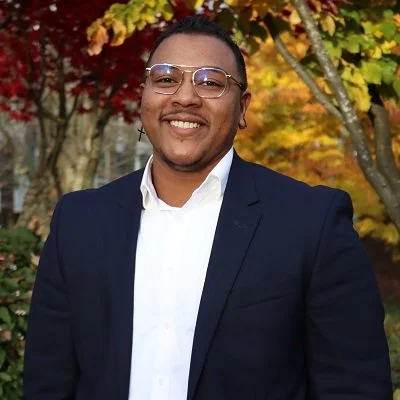
Jeremiah J. Henderson, MPA (He/They) is a third-year medical student at OHSU. Prior to medical school, they spent nearly a decade engaged in policy advocacy, equity, and justice work. He is driven by a commitment to not merely participate in the existing healthcare system but to fundamentally reshape it in ways that center patients most impacted by inequities. Outside of medicine, they find joy in queer community, collective dreaming, and rainy PNW days.